Postcard From Scotland - 2009.
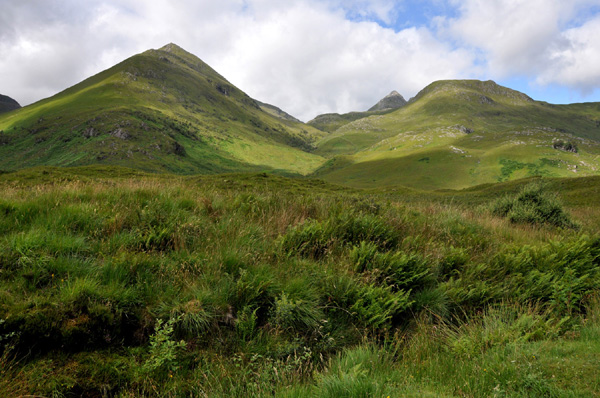
Glen Shiel, Scotland.
Scotland,
July 2009
The weather
is dry and not as cold as we have almost expected when we land in Edinburgh on
this Monday in July 2009. The rain does not start until two minutes later when
we are being transported by bus from the plane to the arrival building – and
after we have picked up our Mercedes 190E Automatic the showers continue as we
head north on the M90 across the Forth Bridge and through Perth towards out
first stop in the town of Pitlochry on the edge of the Highlands. We are
travelling with Solveig’s sister and brother-in-law, Gunhild and Gert, and we
have booked rooms for our first night in Scotland at the Tigh Na Cloich Hotel
overlooking the town and valley. Pitlochry is a pretty little town dominated by
grey stone houses – and after a stroll down the main street we have dinner under
a clear sky at the Port Na Craig Inn with a beautiful riverside location in the
western part of town.
The
following morning we have decided for the so-called Killiecrankie Walk
before we head north to our next stop. According to our travel guide the walk is
13 kilometers long and easy – because the path the whole way follows the
riverside and the banks of Loch Faskally – so we are expecting to complete the
round in a couple of hours or maybe a bit more. Steep hillsides and cliffs rise
from the lake and river to all sides and with a clear sky on our side the walk
through the woods of the beautiful glen is nice and refreshing, although longer
than expected. Halfway at the Clunie Foot Bridge we have used over two hours and
after we cross the River Tummel and reach the woods on the other side, dark
clouds begin to build up above us – and soon it starts to rain. We are hoping it
is just a light shower, but it is not. The raindrops grow large and heavy and
before long the rain just pours without mercy for a full hour as we are trotting
northwards and cross a branch of the river via the Coronation Bridge, built in
1860 in honor of George IV. In spite of our coats and jackets and ponchos, all
of us are now soaking wet – and at one point I am beginning to seriously fear
that my camera and cell phone and all other electronic equipment will just
simply drown in the flood. But suddenly the rain stops, and during the last hour
of the walk we are all again able to see the forest, the hills and the tumbling
river – through our stained eyeglasses. The experience is a lesson: Do not
underestimate a Scottish shower. It can hit you anytime and anywhere – and the
raindrops are large and heavy.
The next
days we are staying at the small Hotel Benleva in the village of Drumnadrochit –
in the middle of the Highlands and close to Loch Ness. With the shape we are in,
the impressive ruins of Urquhart Castle on the lochside are within walking
distance from our hotel – and in the Mercedes we go for day trips to the
Isle of Skye in the west and to the Dornoch Firth and the city of Inverness in
the northeast. Particularly the trip to Skye is phenomenal. We have sunshine and
a clear sky the whole day and see some magnificent landscapes in the valley of
Glen Shiel on our way to the coast – and later, on Skye itself, the steep Old
Man of Storr and the tall flat range of Quirraing near the north tip
of the island. From the cliffs at Duntulm Castle in the northwest we have a
clear view over the Atlantic Ocean with the westernmost Isle of Lewis in
the horizon. Everywhere in these remote parts, the glens and mountain sides form
large and open landscapes with no trees, no cultivated fields and for miles and
miles hardly a building or house – but always with a rich growth of either
heather and grass or ferns, mosses and other low plants in all possible shades
of lush green. Down the hillsides water is flowing everywhere, soon
gathering into sparkling streams and at the bottom of the glens, into roaring
rivers.
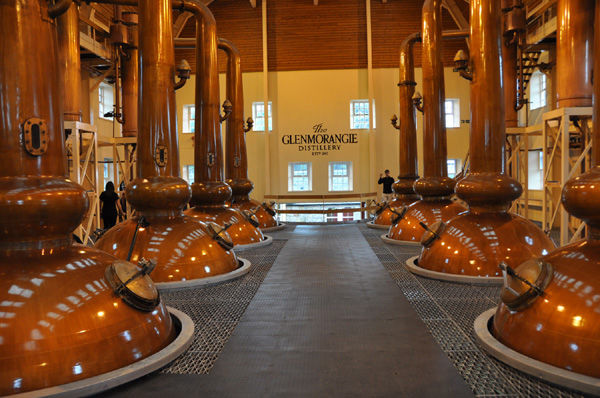
Glenmorangie Distillery, Tain.
Hotel
Benleva houses the most popular restaurant and pub of the village, and in the
evening – together with a crowd of local guests – we enjoy a pint or two of the
traditional Scottish ales on draught, most of them from the tiny Isle of Skye
Brewery in the town of Uig on the west coast of the island. The pub also offers
a hundred or more different malt whiskeys – and you can taste the malt of the
month (Jura) for £ 1,95. Benleva’s restaurant is excellent too – serving
several kinds of great seafood and for example lamb spiced with garlic and curry
or chicken with crispy vegetables and new potatoes.
Another
daytrip goes north to the Dornoch Firth and the village of Edderton – which on
an open field outside of town has an ancient Pictish standing stone with magic
symbols and strange inscriptions. On the same trip we pay a visit to the
Glenmorangie Distillery in the town of Tain and spend a few hours of the
afternoon visiting the biggest city of the Highlands, Inverness – with a
magnificent castle, the great river Ness and some streets and houses in the
center sadly destroyed by brutal and unfortunate city improvements of the 1970’s
and 1980’s.
After
Benleva and Loch Ness we head down the Great Glen which cuts diagonally
through the Highlands from Inverness in the northeast to Fort William and Loch
Linnhe in the southwest. On this stretch the lochs line up numerously like
pearls on a string, surrounded on both sides by green and tall slopes with Ben
Nevis at 1344 meters as the highest peak in all of Great Britain. From Inchree
and Onich we head inland and climb to the phenomenal ravine of Glen Coe where
the bright green slopes reach into the sky and we run into another heavy shower
just when we have found the perfect spot for a walk by the river. In the evening
we stay at the Inverbeg Inn on the bank of Loch Lomond – and it is in full
harmony with our spirits when on this Saturday evening the musical couple
performing at the restaurant of the inn round up a series of traditional rock
and folk song with the classic ballad of Loch Lomond – ”Oh ye'll take the high
road and I'll take the low road / And I'll be in Scotland afore ye / But me and
my true love will never meet again / On the bonnie, bonnie banks of Loch
Lomond”.
We spend
the last days of our journey in the old city of Edinburgh, situated majestically
on a hill on the south side of the Firth of Forth on the east coast of Scotland.
The center of the town covers a relatively small area and everything is within
walking distance both in the old town at the top and in the new town further
down. The old town is dominated by a single street called The Royal Mile which
runs from the new parliament building and the Castle of Holyrood at the lower
end to the vast Edinburgh Castle at the top. Over the full mile the street is
lined by magnificent unbroken rows of tall and old stone buildings. Some of the
houses hold small museums – and you can easily spend a day or two just wandering
in and out of the old houses and maybe in between stopping for a Scottish mocca,
latte or cappuccino at one of the cafes. On the last day we round up our visit
to Scotland with a hike to the top of the steep Holyrood hill forming a pleasant
backdrop to the city landscape. The path rises steeply to the top of the green
hill with a great view over the city – and it is not until we have returned
safely back down to the busy streets that once again the Celtic sky cracks open
and the rain begins to pour...
Written on July 24, 2009
This rewrite in English made on July 27 and July 30, 2009
//Niels
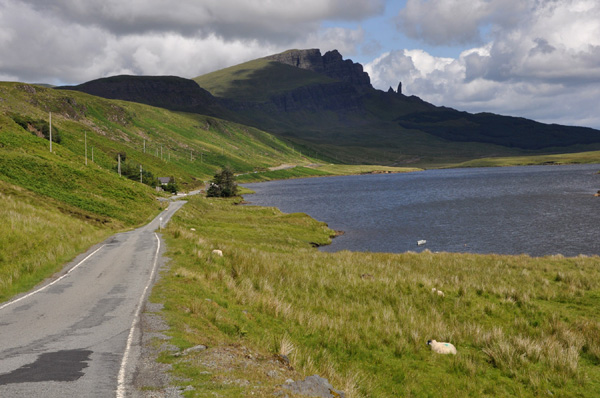
Old Man of Storr, Isle of Skye.
More
photos
are
available here:
http://www.dinnesen.com/albums/Scotland_2009_2/index.html
.